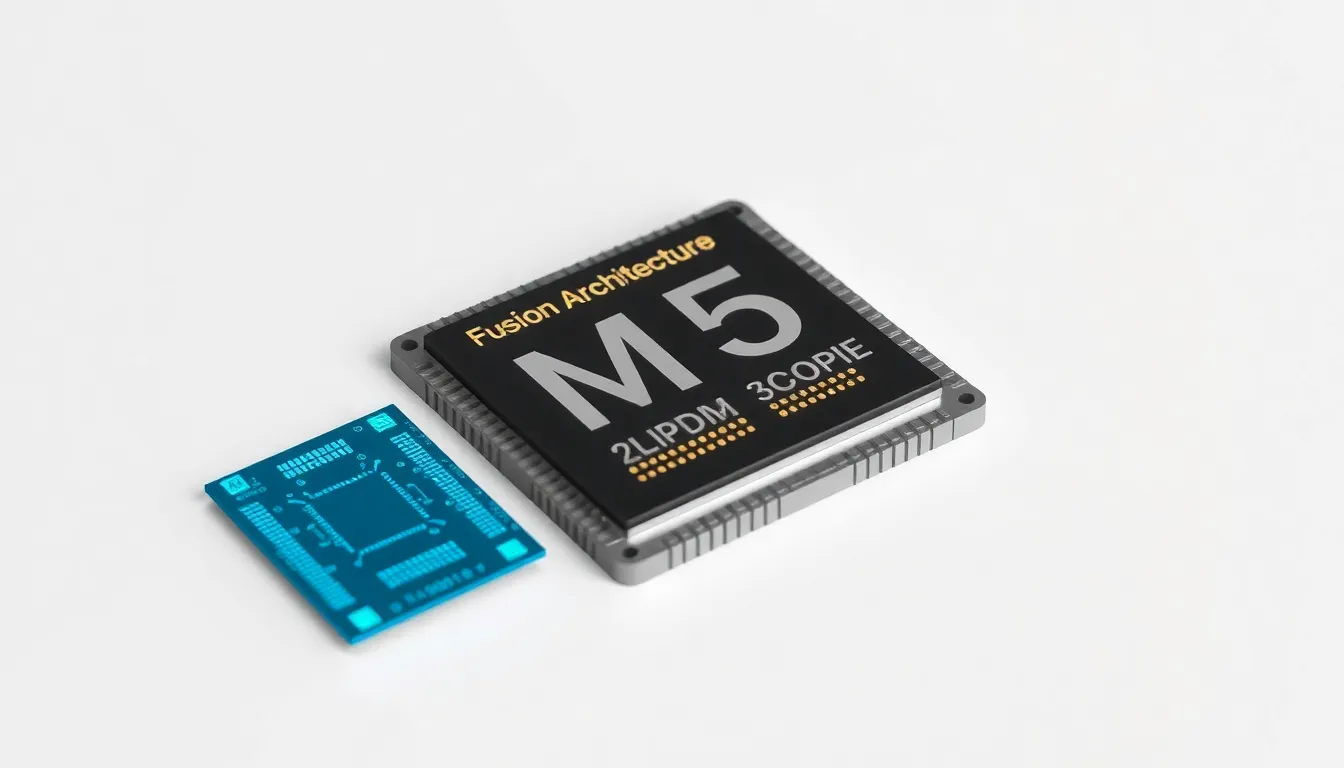
Apple Unveils M5 Pro and M5 Max Chips with Fusion Architecture and Super Cores
Apple has officially announced its next-generation M5 Pro and M5 Max chips, marking a significant evolution in its silicon design with the introduction of a new Fusion Architecture and specialized "super cores." These chips are poised to power the upcoming MacBook Pro models, delivering substantial performance gains for professional users.
Revolutionary Fusion Architecture
The M5 Pro and M5 Max represent Apple's first chips to utilize the new Fusion Architecture, which combines two third-generation 3-nanometer dies through advanced packaging technology. This innovative approach allows for greater scalability and integration of components across the system-on-a-chip.
Both chips share a common foundation that includes an 18-core CPU, scalable GPU architecture, Media Engine, unified memory controller, Neural Engine, and Thunderbolt 5 capabilities. The unified design across Pro and Max variants represents a departure from previous generations where core configurations differed between the two tiers.
Advanced CPU Design with Super Cores
At the heart of both M5 Pro and M5 Max chips lies an 18-core CPU configuration featuring 6 "super cores" and 12 performance cores. While the naming convention has evolved, these essentially correspond to the performance and efficiency cores of previous generations, but with significant architectural improvements.
The new super cores are designed to deliver industry-leading single-threaded performance through increased bandwidth, a redesigned cache hierarchy, and enhanced branch prediction capabilities. Meanwhile, the performance cores have been optimized for power-efficient multithreaded performance in professional workloads. Apple claims the new CPU architecture delivers up to 40% performance improvement over previous generations.
Enhanced Graphics and AI Capabilities
The graphics capabilities see substantial upgrades across both chips. The M5 Pro comes equipped with a 20-core GPU and 16-core Neural Engine, while the M5 Max offers configurations with either 32-core or 40-core GPU options. Each graphics core now includes a Neural Accelerator and benefits from higher unified memory bandwidth.
These enhancements translate to significant performance gains in specialized workloads. The new GPU architecture delivers a 4x improvement in peak AI compute performance compared to M4 Pro and M4 Max chips, while ray tracing performance sees a 35% increase. The Neural Engine also benefits from the increased memory bandwidth, accelerating machine learning tasks.
Availability and Implementation
The M5 Pro and M5 Max chips will debut in the new MacBook Pro 14-inch and 16-inch models, with pre-orders beginning shortly after announcement. The chips represent Apple's continued commitment to vertical integration and performance optimization for professional creative and technical workflows.
The Fusion Architecture approach suggests Apple is focusing on creating more unified silicon platforms that can scale across different product tiers while maintaining core architectural advantages. This strategy could streamline development while ensuring consistent performance characteristics across the product lineup.
Conclusion
Apple's M5 Pro and M5 Max chips represent a significant step forward in the company's silicon development, introducing architectural innovations that promise substantial performance improvements for professional users. The Fusion Architecture and specialized super cores demonstrate Apple's continued focus on optimizing both single-threaded and multithreaded performance while enhancing AI and graphics capabilities.
As these chips begin shipping in new MacBook Pro models, they're expected to set new benchmarks for performance in creative applications, development environments, and scientific computing. The unified approach across Pro and Max variants suggests Apple is refining its silicon strategy to deliver more consistent performance scaling across its professional product lineup.